 4a057bf3d5
2 configurations for the listeners are now possible: - enableJWT=false with client ssl auth - enableJWT=true with https Actual verification of the tokens is handled by https://github.com/openshift-online/ocm-sdk-go. An authentication handler is run as the top level handler, before any routing is done. Routes which do not require authentication should be listed as exceptions. Authentication can be restricted using an ACL file which allows filtering based on JWT claims. For more information see the inline comments in ocm-sdk/authentication. As an added quirk the `-v` flag for the osbuild-composer executable was changed to `-verbose` to avoid flag collision with glog which declares the `-v` flag in the package `init()` function. The ocm-sdk depends on glog and pulls it in. |
||
|---|---|---|
| .. | ||
| .codecov.yml | ||
| .gitignore | ||
| .travis.yml | ||
| adapter.go | ||
| any.go | ||
| any_array.go | ||
| any_bool.go | ||
| any_float.go | ||
| any_int32.go | ||
| any_int64.go | ||
| any_invalid.go | ||
| any_nil.go | ||
| any_number.go | ||
| any_object.go | ||
| any_str.go | ||
| any_uint32.go | ||
| any_uint64.go | ||
| build.sh | ||
| config.go | ||
| fuzzy_mode_convert_table.md | ||
| go.mod | ||
| go.sum | ||
| Gopkg.lock | ||
| Gopkg.toml | ||
| iter.go | ||
| iter_array.go | ||
| iter_float.go | ||
| iter_int.go | ||
| iter_object.go | ||
| iter_skip.go | ||
| iter_skip_sloppy.go | ||
| iter_skip_strict.go | ||
| iter_str.go | ||
| jsoniter.go | ||
| LICENSE | ||
| pool.go | ||
| README.md | ||
| reflect.go | ||
| reflect_array.go | ||
| reflect_dynamic.go | ||
| reflect_extension.go | ||
| reflect_json_number.go | ||
| reflect_json_raw_message.go | ||
| reflect_map.go | ||
| reflect_marshaler.go | ||
| reflect_native.go | ||
| reflect_optional.go | ||
| reflect_slice.go | ||
| reflect_struct_decoder.go | ||
| reflect_struct_encoder.go | ||
| stream.go | ||
| stream_float.go | ||
| stream_int.go | ||
| stream_str.go | ||
| test.sh | ||






A high-performance 100% compatible drop-in replacement of "encoding/json"
You can also use thrift like JSON using thrift-iterator
Benchmark
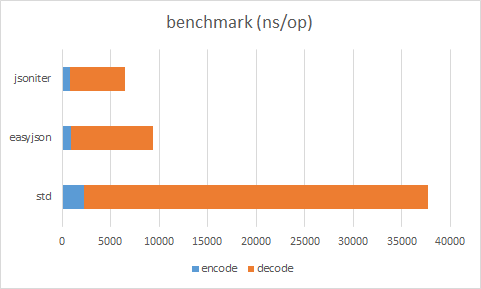
Raw Result (easyjson requires static code generation)
| ns/op | allocation bytes | allocation times | |
|---|---|---|---|
| std decode | 35510 ns/op | 1960 B/op | 99 allocs/op |
| easyjson decode | 8499 ns/op | 160 B/op | 4 allocs/op |
| jsoniter decode | 5623 ns/op | 160 B/op | 3 allocs/op |
| std encode | 2213 ns/op | 712 B/op | 5 allocs/op |
| easyjson encode | 883 ns/op | 576 B/op | 3 allocs/op |
| jsoniter encode | 837 ns/op | 384 B/op | 4 allocs/op |
Always benchmark with your own workload. The result depends heavily on the data input.
Usage
100% compatibility with standard lib
Replace
import "encoding/json"
json.Marshal(&data)
with
import jsoniter "github.com/json-iterator/go"

var json = jsoniter.ConfigCompatibleWithStandardLibrary
json.Marshal(&data)
Replace
import "encoding/json"
json.Unmarshal(input, &data)
with
import jsoniter "github.com/json-iterator/go"

var json = jsoniter.ConfigCompatibleWithStandardLibrary
json.Unmarshal(input, &data)
How to get
go get github.com/json-iterator/go
Contribution Welcomed !
Contributors
Report issue or pull request, or email taowen@gmail.com, or